
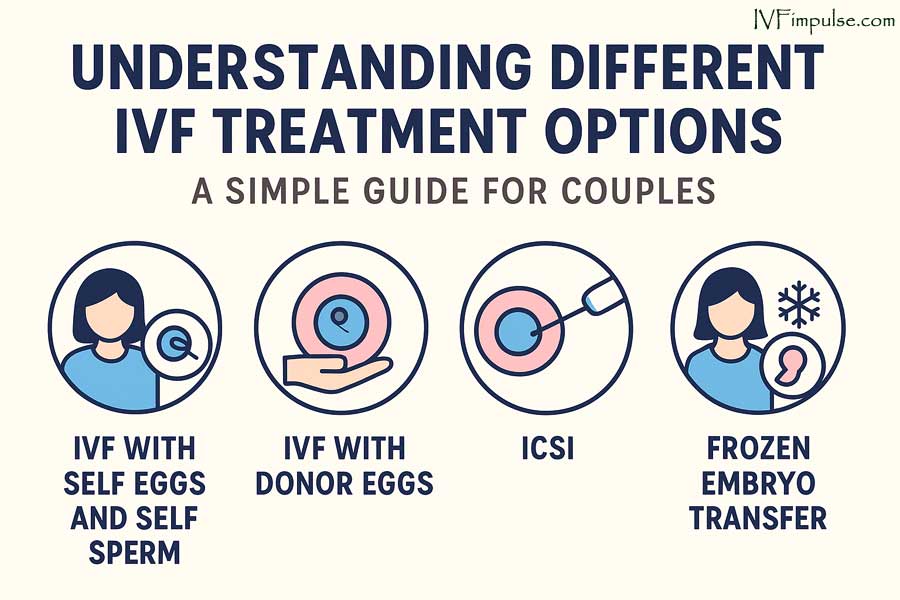

Infertility affects millions of couples, but today, modern fertility treatments, especially IVF, give real hope. When you understand how IVF works, its different options, and which treatment suits your situation, the journey becomes easier and less stressful.
This guide explains IVF treatment options in a simple, clear, patient-friendly way.
What Is IVF?
IVF (In Vitro Fertilization) is a treatment where eggs and sperm are combined outside the body, embryos are formed, and then the healthiest embryo is placed back into the uterus.
It is recommended for:
- Blocked or damaged fallopian tubes
- Low sperm count/motility
- PCOS or irregular ovulation
- Unexplained infertility
- Recurrent pregnancy loss
For couples trying naturally, you may also explore tips to boost natural conception chances—a helpful guide is available on IVFImpulse.
1. IVF With Self Eggs and Self Sperm
This is the most common IVF cycle.
Best for:
- Young couples
- PCOS
- Minor male-factor issues
- Unexplained infertility
Process includes:
- Ovarian stimulation
- Egg retrieval
- Sperm collection
- Fertilization (IVF/ICSI)
- Embryo transfer
If you’re preparing for treatment, maintaining reproductive health is essential. IVFImpulse has a helpful guide on preventing infertility and improving reproductive health.
2. IVF With Donor Eggs
Used when the woman has:
- Low AMH
- Poor ovarian reserve
- Premature ovarian failure
- Genetic diseases
Donor-egg IVF generally has higher success rates, especially for women above 38.
3. IVF With Donor Sperm
Recommended when:
- Male partner has azoospermia
- Severe sperm abnormalities
- Genetic problems
This method is very safe and widely used across fertility centres.
4. ICSI (Intracytoplasmic Sperm Injection)
ICSI is a technique where a single selected sperm is injected into an egg.
Best for:
- Extremely low sperm count
- Poor motility
- Previous failed fertilization in IVF
Most modern clinics use ICSI in 70–80% of cases.
5. Frozen Embryo Transfer (FET)
Instead of transferring fresh embryos, doctors freeze them and transfer them in a later natural or prepared cycle.
Why FET is popular:
- Higher implantation rates
- Better hormonal balance
- More flexibility
- Safer for women with high stimulation response
6. IVF With Egg Freezing / Sperm Freezing
Cryopreservation is a great option for couples who want to preserve fertility for the future.
IVFImpulse already has a popular article explaining this in simple language, about Egg and sperm freezing: costs, benefits & success rates
7. IVF With PGT (Pre-implantation Genetic Testing)
PGT helps check embryos for genetic problems before transfer.
Recommended in:
- Recurrent miscarriages
- Family history of genetic disease
- Advanced maternal age
This increases the chance of a healthy pregnancy.
8. Surrogacy
Surrogacy may be required when a woman cannot carry a pregnancy due to:
- Absent uterus
- Repeated IVF failures
- Severe medical conditions
Surrogacy is tightly regulated in India, and only legally permitted under specific medical reasons.
Success Rate of IVF
IVF success depends on many factors:
| Age of woman | Expected IVF success rate |
|---|---|
| Below 30 | 55–65% |
| 30–35 | 45–55% |
| 35–40 | 35–45% |
| Above 40 | 15–25% |
Lifestyle also plays a major role. A balanced diet, exercise, adequate sleep, and stress control improve outcomes.
In Conclusion
IVF provides multiple treatment pathways depending on the couple’s medical situation. Understanding these options helps in making confident decisions with your fertility specialist.
For more fertility tips, nutrition advice, and treatment guidance, keep visiting IVFImpulse.com—your trusted companion on the IVF journey.
FAQ Section
1. Which type of IVF treatment is best for me?
The best IVF option depends on your age, AMH levels, sperm health, medical history, and previous treatment outcomes. A fertility specialist evaluates all factors before recommending the right cycle.
2. Is donor egg IVF better than IVF with self eggs?
Donor egg IVF has higher success rates, especially for women above 38 or those with low AMH or poor ovarian reserve.
3. What is the difference between IVF and ICSI?
In IVF, eggs and sperm are combined naturally in a lab dish. In ICSI, a single sperm is injected directly into an egg—ideal for severe male-factor infertility.
4. Is FET (Frozen Embryo Transfer) better than fresh transfer?
FET often gives higher success because the woman’s hormones are more stable, resulting in better implantation.
5. Can IVF guarantee pregnancy?
No. IVF improves chances but does not guarantee pregnancy. Success depends on factors like age, egg quality, sperm health, and embryo grade.